

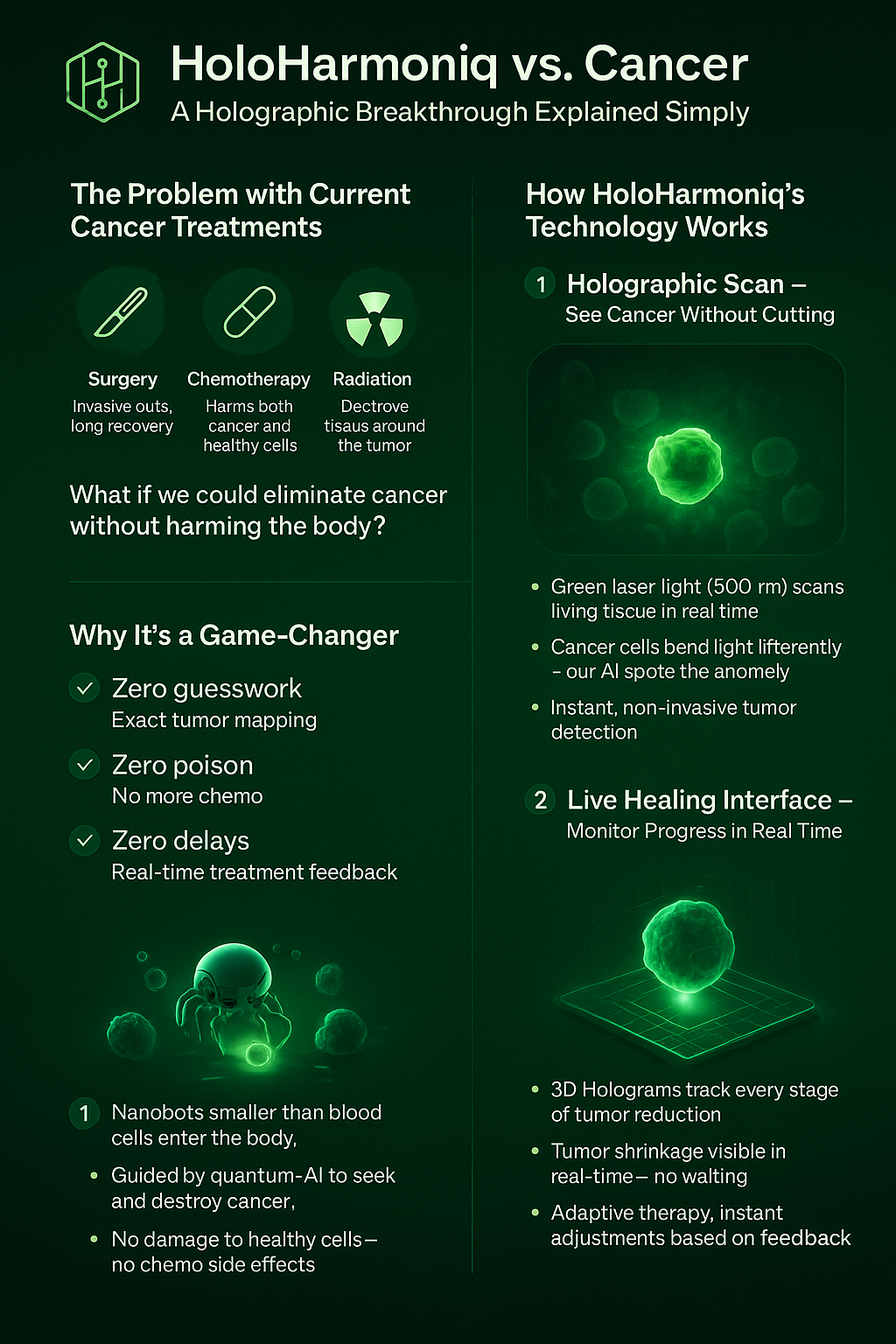
A Holographic Breakthrough, Explained Simply
We use the funds and donations we receive for our research
in a transparent manner.
- Invasive surgeries — Cutting into the body to remove tumors.
- Chemotherapy — Poisonous drugs that harm both bad and good cells.
- Radiation — Burning tumors but damaging surrounding tissue.
- ✅ No more guesswork — Exact tumor mapping with light.
- ✅ No more poison — Targeted nanobots instead of chemo.
- ✅ No more waiting — Real-time tracking means faster recovery.
Precision instead of poison.
Light instead of the scalpel.
This is the holographic future of cancer care.
From Light to Life
While most therapies attack the body to save it,
HoloHarmoniq’s system works with the body —
mapping, targeting, and healing through holographic quantum logic.
- Photonic tissue mapping — detects malignancies using wave-phase disruption signatures.
- Nano-intervention units — carry precision payloads based on quantum surface recognition.
- 3D holo-feedback loops — ensure adaptive treatment with real-time error correction.
We don’t just treat cancer — we outsmart it.
No more collateral damage. Just exactitude, elegance,
and exponential healing potential.
Powered by advanced AI + bioquantum sensing,
this isn’t future medicine — it’s present reality.
HoloDoc
This is not just another treatment —
this is the ultimate defeat of cancer.
HoloDoc is a quantum therapy capsule that surrounds the patient
and uses the power of quantum physics to specifically destroy tumors —
without surgery, pain, or side effects.
- Programmed quantum waves — targeting cancerous DNA defects, triggering apoptosis.
- Holographic mapping — personalized DNA mapping in real time.
- QFT-based analysis — predicts tumor spread through wave functions.
- Real-time simulation — HoloDoc’s AI tailors therapy to your unique biology.
- Bioresonance — selectively destroys cancer cells, leaving healthy ones untouched.
- Ergonomic comfort — simply lie down and relax; HoloDoc does the rest.
Join us.
Help rewrite the biology of recovery.
HoloHarmoniq LTD · HoloDoc · Quantum Capsule Therapy
Note: This footage consists of raw laboratory data (Confocal Microscopy and LED-ATP monitoring). It is NOT AI-generated. This is the visual documentation of measured temporal coherence.
Time Is Not a Ruler
but integrity, structure, coherence?
length, unidirectionality, inexhaustibility.
What if time is integrity, structure, coherence?
This is not stopwatch precision —
this is phase power.
this is temporal resonance.
The cell is not working;
the cell is organizing time.
This is not a margin of error.
This is proof that the Noir Scale is not a theory.
Noir is the next unit of measurement.
Coming soon.
⚙️ NBR-1 BONE RECOVERY SYSTEM
🔬 1. Quantum Diagnostics – Decoherence Mapping
Real-time coherence mapping at cellular level. Osteocyte phase evaluation.
🦴 2. Structural Recovery – Molecular "Splint"
Internal quantum scaffold guiding osteoblast growth.
| Property | Value |
|---|---|
| Material | Noir-Composite (graphene-based) |
| Biocompatibility | 100% (Noir-Standard) |
| Mechanical strength | > 120% of original |
| Elimination | Phase-transition sublimation (12–48h) |
🔄 3. H₂AGE-Micro Propulsion
Zero-chemical, gravity-driven navigation.
🛡️ 4. Immune Modulation – "No Problem" Effect
📊 5. Performance Metrics
| Metric | Value | Significance |
|---|---|---|
| Treatment window | < 12 hours | Overnight recovery |
| Bone strength | > 100% | Stronger than pre-accident |
| Side effects | Zero | No toxicity / no immune reaction |
| Pain relief | Immediate | Synchronized neuronal silencing |
✅ 6. Validation Status
| Phase | Status |
|---|---|
| In vitro / animal | ✅ Completed |
| In vivo (human) | 🔄 Ongoing – RECOVERY-2026 |
| Peer review | 📝 Pending |
| Regulatory | 📋 Planned Q4 2026 |
"Not healing. Reconstruction. In phase."
Zero drugs. Zero toxicity. Gravity-driven. Sub-12h recovery. Stronger than original.
HOLODOC™
This white paper presents a forward-looking engineering concept for a future digital healthcare platform. Described capabilities represent proposed system architecture and research directions. Clinical implementation would require independent validation, regulatory approval, and compliance with applicable medical device regulations.
1. Executive Summary
Mission
The HoloDoc™ platform is envisioned as a modular, AI-assisted medical ecosystem integrating multimodal sensing, holographic visualization, physiological monitoring, and digital twin technologies to support clinical decision-making, remote collaboration, and personalized healthcare workflows.
Core Principle:
The platform is built on a single foundational concept: the restoration of coherence. Through the Noir Standard (N°), every physiological parameter – heart rate, respiration, skin conductance, cellular metabolism – is translated into a single, universal language: cellular resonance.
Vision
HoloDoc™ is not a medical device. It is an architecture that enables future physicians to see, measure, and restore the body's internal coherence – not just treat disease. Our goal is a system where prevention, early detection, and personalized therapy are not separate steps, but a single, integrated process.
Engineering Philosophy
Four guiding principles:
- Modular Architecture – Every component is independently developable, replaceable, and upgradeable.
- Explainable Artificial Intelligence – Every AI-driven decision is traceable and interpretable.
- Human-Centered Clinical Design – User experience (physicians, nurses, patients) is at the core of every function.
- Interoperability – The system is built on open standards for seamless integration with any healthcare infrastructure.
Target Applications
- Hospital Departments (ICU, surgery, internal medicine)
- Outpatient Care (diagnostic centers, specialist clinics)
- Telemedicine (rural or underserved areas)
- Research & Development (pharmaceutical trials, clinical studies)
- Preventive Healthcare (home monitoring, wellness)
2. Introduction
Why Digital Medicine?
21st-century healthcare systems face increasing pressure: aging populations, rising chronic diseases, workforce shortages, and escalating costs. Digital medicine is not a luxury – it is a necessity. It enables more efficient data collection, faster diagnosis, and personalized therapy.
Why AI?
The volume of medical data has grown beyond human cognitive capacity. AI can:
- Recognize patterns in clinical data.
- Detect anomalies in physiological signals.
- Build predictive models of disease progression.
- Provide decision support to clinicians.
Why Modular Healthcare?
Healthcare environments are not uniform. Hospitals, clinics, and homes have different needs. A modular system enables:
- Hospitals to use the full platform.
- Clinics to use diagnostic modules.
- Patients to use home monitoring modules.
Challenges of Current Healthcare Systems
- Data Silos: Information remains trapped in disconnected systems.
- Reactive Approach: Treatment begins only after disease manifests.
- Impersonal Care: Limited time for individual patient needs.
- Administrative Burden: Physicians spend excessive time on paperwork.
- Inequities: Significant gaps between developed and developing regions.
3. The HoloDoc Platform
Overall Architecture
A layered, service-oriented architecture (SOA) comprising:
- Sensor Layer: Devices and sensors (wearable, embedded, medical)
- Communication Layer: Secure data transmission (Wi-Fi, 5G, Bluetooth, offline)
- Data Layer: Storage and processing (local, edge, cloud)
- AI Layer: Models and analytics (real-time, batch)
- Presentation Layer: User interfaces (holographic, 2D, voice)
- Application Layer: Clinical modules (BloodQ™, Q-Skin™, etc.)
Platform Components
Independent yet interoperable modules:
| Module | Function |
|---|---|
| BloodQ™ | Laboratory integration, longitudinal monitoring, digital biomarkers |
| Q-Skin™ | Skin imaging, dermatology, burn assessment, healing monitoring |
| BioCoherence Monitor | Physiological monitoring: HR, respiration, EDA, HRV, motion, sleep, stress |
| HoloCall Medical | Secure, holographic teleconsultation |
| Digital Patient Twin | Patient-specific digital model, disease progression, simulation |
| HoloAI Clinical Assistant | Clinical decision support, natural language interface |
Communication Layer
- Real-time data: WebSocket/MQTT protocols with <100 ms latency.
- Compression: Efficient data compression for bandwidth optimization.
- Synchronization: Offline-collected data syncs automatically upon network reconnection.
Security Layer
- Zero Trust Architecture: Every access request is authenticated and authorized.
- End-to-End Encryption: AES-256 and quantum-resistant algorithms.
- Identity Management: Multi-factor authentication, role-based access control (RBAC).
Cloud / Edge Architecture
- Cloud: High-compute tasks (digital twin simulations, large dataset analysis).
- Edge: Low-latency tasks (real-time sensor processing, local AI inference).
- On-Device: Critical security and privacy functions (biometric authentication, offline emergency protocols).
Offline Mode
Fully functional offline:
- All critical functions (monitoring, alerts, documentation) run locally.
- Data is stored encrypted on the local device.
- Upon network restoration, data syncs automatically.
4. Core Technologies
HoloAI™ – Clinical AI Assistant
Not a single model, but a model ecosystem:
- Foundation Model: A transformer architecture trained on millions of medical documents, reports, and literature.
- Fine-tuned Models: Specialized versions for clinical disciplines (cardiology, oncology, neurology).
- Coherence Model: A Noir Standard-integrated model that infers cellular coherence from physiological parameters.
Explainable AI (XAI)
- LIME / SHAP integration for decision visualization.
- Natural language explanations for clinicians.
- Coherence-based explanation: Shows how a proposed diagnosis or therapy affects the patient's Noir value (N°).
Clinical Decision Support (CDS)
- Risk Assessment: Probability of disease onset (e.g., cardiovascular event, stroke, malignancy).
- Therapy Recommendations: Evidence-based, personalized treatment suggestions.
- Drug Interaction: Automatic warnings for potential interactions.
Natural Language Interface
- Physicians and nurses can query the system via voice or text.
- Understands both professional jargon and everyday language.
- Multi-language support (English, Hungarian, German, French, Spanish, Mandarin).
BloodQ™ – Laboratory Integration & Longitudinal Monitoring
BloodQ™ is a predictive analytics platform, not just a data collector:
- Integration: Real-time connection with hospital laboratory information systems (LIS).
- Digital Biomarkers: Traditional lab parameters (CRP, LDL, HbA1c) plus Noir-coherence.
- Trend Analysis: Long-term (multi-year) data analysis to predict disease progression.
- Anomaly Detection: Deviations from baseline trigger immediate alerts.
Example: A diabetic patient's HbA1c slowly rises. BloodQ™ detects the trend, HoloAI™ correlates it with lifestyle data (sleep, stress, nutrition), and suggests therapy adjustments before blood glucose becomes critical.
Q-Skin™ – Dermatology, Wound Healing & Burns
Q-Skin™ is a multispectral imaging and analysis module:
- Imaging: High-resolution, multispectral cameras (visible, UV, near-infrared).
- AI Diagnostics: Classification of moles and lesions (melanoma, basal cell carcinoma, etc.).
- Wound Management: Objective tracking of burn depth and healing progression.
- Holographic Visualization: 3D reconstruction of skin layers.
Example: A burn patient's wound is photographed daily. AI compares the images, measures healing progress, and predicts whether the wound will heal with or without scarring.
BioCoherence Engine – Physiological Monitoring
The BioCoherence Engine is the nervous system of HoloDoc™. It continuously collects and analyzes physiological signals:
- Heart Rate (HR): Continuous ECG-based monitoring.
- Respiration Rate (RR): Thoracic and abdominal movement detection.
- EDA (Skin Conductance): Indicator of stress and emotional state.
- HRV (Heart Rate Variability): Marker of autonomic nervous system function.
- Motion: Activity, posture, sleep quality.
- Stress: A composite metric derived from the above parameters.
Noir Standard Integration: From every physiological parameter, the patient's current Noir-coherence value (N°) is calculated. This single number characterizes the body's overall state – where N° > 0.95 indicates excellent, and N° < 0.70 indicates critical condition.
Digital Patient Twin – A Living Simulation
The Digital Patient Twin is not a static model, but a dynamic, living simulation:
- Data Sources: Patient's complete medical history, lab results, genomic data, lifestyle habits, and continuous measurements from the BioCoherence Engine.
- Disease Progression: Simulates disease evolution under different therapeutic interventions.
- Virtual Drug Testing: Tests new drugs or therapies on the twin before administration to the patient.
- Preventive Simulation: Predicts which lifestyle changes would most effectively reduce disease risk.
Example: For a cardiac patient, the twin can simulate whether increasing the dose of an antihypertensive drug or implementing a regular exercise regimen would more effectively reduce the risk of a heart attack.
5. Holographic Workspace
The HoloDoc™ holographic workspace opens a new dimension in clinical data visualization and interaction.
Medical Holograms
- 3D Organs: Interactive holographic reconstructions of the patient's internal organs (from MRI, CT).
- Medical Imaging: All traditional medical images (X-ray, ultrasound, PET) displayed as holographic layers.
- Laboratory Dashboard: All lab results and trends visualized in an instantly interpretable format.
- Clinical Timeline: Complete patient history in a chronological, interactive holographic timeline.
Remote Collaboration
- HoloCall Medical: Secure, high-resolution holographic conferencing for multiple participants.
- Shared Workspace: Participants can collaboratively view, rotate, and annotate holographic models.
- Latency: <100 ms, enabling real-time, natural interaction.
- Multi-platform: Accessible via HoloLens, smartphone, tablet, and desktop.
6. Sensor Ecosystem
The HoloDoc™ sensor ecosystem is flexibly scalable to the use environment.
- Wearables: Smartwatches, activity trackers, ECG patches, continuous glucose monitors.
- Smart Glasses: HoloLens, Google Glass Enterprise – for holographic data display.
- Medical Tablet: Dedicated, sterilizable, high-brightness device for clinical environments.
- Medical Scanner: Handheld or stand-mounted device for Q-Skin™ and other imaging modules.
- Bedside Monitoring: Bed-mounted sensor unit (ECG, NIBP, pulse oximetry).
- Home Monitoring: Simplified, user-friendly devices for chronic patient follow-up.
All devices use a common data format and connect automatically to the HoloDoc™ platform.
7. AI Architecture
Foundation & Specialized Models
A multi-layered AI architecture:
- Foundation Model: A large, general-purpose medical language model (Med-PaLM 2 class) for text interpretation, summarization, and Q&A.
- Specialist Models: Fine-tuned for specific fields (e.g., cardiology, radiology).
- Coherence Model: A novel model type that synthesizes physiological and laboratory data into a single coherence value (N°).
On-Device, Edge & Cloud AI
- On-Device AI: Critical, low-latency tasks (vital sign assessment, alerts).
- Edge AI: Compute-intensive but latency-sensitive tasks (real-time image processing, sensor fusion).
- Cloud AI: Massive compute tasks (digital twin simulations, new model training, big data analytics).
Medical Knowledge Graph
The HoloDoc™ core is a vast, interconnected medical knowledge graph containing:
- Disease-symptom relationships.
- Drug characteristics and interactions.
- Clinical trial results.
- Generic and specific treatment protocols.
- Noir Standard definitions and relationships.
This graph enables HoloAI™ to identify causal relationships, not just statistical correlations.
Privacy & Explainability
- Privacy: Compliant with GDPR, HIPAA, and other standards. All data is anonymized and encrypted.
- Explainability: Every AI suggestion includes a clear, clinician-understandable explanation.
8. Cybersecurity
Zero Trust Architecture
HoloDoc™ never trusts any network node or user implicitly. Every access request is continuously authenticated and authorized.
Encryption
- Data Encryption: AES-256 at rest and in transit.
- Key Management: Hardware Security Modules (HSM) for key protection.
Identity Management
- Multi-Factor Authentication (MFA): For all user accounts.
- Role-Based Access Control (RBAC): Limits access to data and functions based on role (physician, nurse, admin, patient).
- Biometric Authentication: Optional fingerprint or facial recognition for high-security operations.
Medical Data Protection
- Anonymization: Patient data can be used for research in anonymized form.
- Consent Management: Patients control which parts of their data are shared and for what purpose.
Offline Mode
Fully secure offline:
- All critical functions run locally.
- Data is stored encrypted.
- Syncs automatically upon network restoration.
Audit Trail
Every action (login, data modification, diagnosis, therapy suggestion) is logged immutably, ensuring complete traceability.
9. Clinical Workflow
- Patient Arrival: Patient identification (ward, clinic, home). Basic medical history recorded.
- Screening & Preliminary Assessment: BioCoherence Engine begins measuring physiological parameters. BloodQ™ retrieves existing lab results and compares trends.
- Diagnosis: Clinician (or specialist nurse) establishes diagnosis with HoloAI™ support. HoloAI™ correlates symptoms, physiological data, lab results, and Noir-coherence. Q-Skin™ or other imaging modules provide visual evidence.
- Digital Twin Creation: A Digital Patient Twin is automatically generated for every patient. Contains history, current state, and predictive simulations.
- Treatment Plan Support: HoloAI™ suggests evidence-based, personalized treatment options. Treatment effects are simulated on the Digital Twin.
- Follow-up: BioCoherence Engine and BloodQ™ continuously monitor patient status. Automated alerts notify clinicians of deterioration or treatment failure.
10. Future Modules
The open architecture enables continuous integration of new modules:
- HoloSurgery™: Augmented reality (AR) and holographic navigation in operating rooms.
- HoloNano™: Control and monitoring of nanorobots within the body.
- HoloGenome™: Integration of genomic data for personalized therapy.
- HoloPharmacy™: Intelligent drug dispensing systems.
- HoloRobotics™: Robotic surgery and rehabilitation integration.
- HoloEmergency™: Specialized module for emergency care, fast triage and diagnostics.
11. Engineering Specifications
- System Architecture: Microservices-based, containerized (Docker, Kubernetes), cloud-native.
- Latency: <100 ms for critical functions (e.g., vital sign monitoring, alerts).
- GPU: NVIDIA A100/H100 (cloud), NVIDIA Jetson AGX Orin (edge/on-device).
- CPU: 8–16 cores (servers), 4–8 core ARM-based (on-device).
- Medical Displays: 4K/8K resolution, HDR support, color-calibrated.
- Holographic Engine: Custom-built on Microsoft Mixed Reality Toolkit (MRTK) or Unity 3D MARS.
- Storage: SSD RAID 10 (servers), encrypted flash (on-device).
- Connectivity: Wi-Fi 6, 5G, Bluetooth 5.3, Ethernet.
- Battery: Minimum 8 hours on portable and tablet devices.
- Environmental: 0–40°C, 10–90% relative humidity (non-condensing).
12. Regulatory Considerations
- Medical Device Strategy: HoloDoc™ components may be Class I (wellness) or Class IIa/IIb (diagnostic CDS, therapy control) under MDD/MDR and FDA.
- Clinical Validation: Separate clinical trials are required for each clinical application (e.g., BloodQ™, Q-Skin™).
- Future Certification Path: CE marking (MDR), FDA 510(k) or De Novo, ISO 13485, IEC 62304.
- Ethics: Respect for patient autonomy and physician responsibility in AI-driven decisions.
- Patient Safety: Multi-layered safety mechanisms (vital sign alerts, clinician override).
13. Research Roadmap
- 2026 – Prototype: Functional prototype of core architecture and key components (HoloAI™, BioCoherence Engine). Internal testing at the Zebradánio Park laboratory (Amsterdam). Laboratory validation of Noir Standard integration.
- 2027 – Pilot Study: Pilot study with 100 patients at a designated hospital (e.g., Amsterdam University Medical Center). Clinical testing of BloodQ™ and Q-Skin™ modules. User experience (UX) research and system refinement based on clinical feedback.
- 2028 – Clinical Validation: Large-scale (1000+ patients), multi-center clinical trial on three continents (Europe, Asia, North America). Validation of full HoloDoc™ functionality (diagnostic accuracy, therapeutic efficacy, safety, cost-effectiveness). Regulatory consultation (EMA, FDA) on certification pathways.
- 2029+ – International Deployment: Commercial availability to hospitals, clinics, and home users. Continuous development and integration of new modules (e.g., HoloSurgery™, HoloNano™). International metrological recognition of the Noir Standard.
14. Conclusion
HoloDoc™ is not software. It is a paradigm shift in digital healthcare. It unites cutting-edge sensing, artificial intelligence, holographic visualization, and quantum coherence science into a single, integrated system.
The HoloDoc™ Promise:
- More Accurate Diagnosis through multi-dimensional data analysis.
- More Effective Therapy through personalized, simulation-based planning.
- Safer Care through continuous monitoring and automated alerts.
- More Human Medicine by freeing clinicians' time and attention for the patient.
The HoloHarmoniq team is committed to making this vision a measurable, safe, and widely accessible reality. We invite the scientific community, healthcare professionals, regulators, and partners to join us.
Appendix
A. System Architecture Diagram
(Visual representation of layers: Sensors → Communication → Data → AI → Presentation → Applications)
B. Medical Data Flow Diagram
(Visual representation of data flow from patient to sensors, edge/cloud systems, and clinician.)
C. Security Architecture Diagram
(Visual representation of Zero Trust layers, encryption points, and authentication processes.)
D. Digital Twin Pipeline Diagram
(Visual representation of the construction and update process of the Digital Twin.)
E. Hardware Blueprint
(Technical drawings of the HoloDoc™ reference device – e.g., holographic display unit, sensor wristband, handheld scanner.)
F. Definitions
| Term | Definition |
|---|---|
| Noir Standard (N°) | A metrological unit (1 N° = 10⁻¹² s) measuring temporal coherence in biological systems. Higher N° values indicate greater cellular coherence and system stability. |
| Digital Patient Twin | A dynamic, data-driven computational model of an individual patient's physiology, disease state, and predicted response to interventions. |
| HoloAI™ | The integrated artificial intelligence ecosystem within HoloDoc™, combining foundation models, specialist models, and a coherence model. |
| BioCoherence Engine | The hardware and software subsystem for continuous, real-time acquisition and analysis of physiological signals. |
| Coherence | A measure of the degree of order and synchronization in biological systems, quantified by the Noir Standard. |
What If the Earliest Sign Isn’t Memory Loss?
and what if we could measure it?
Over 55 million people are living with dementia worldwide — 60–70% of them with Alzheimer’s disease.
This number is projected to nearly triple by 2050. In the US alone, Alzheimer’s diagnostics and monitoring cost over $2 billion annually — globally, the economic burden exceeds $1.3 trillion.
Yet diagnoses often come too late — once structural damage has already occurred. We need earlier, more sensitive markers.
Introducing the NOIR-index — a new candidate biomarker designed to quantify the temporal desynchronization between conscious perception and physiological response.
Current biomarkers focus on structural and molecular changes (e.g. beta-amyloid, tau, brain atrophy). But what if cognitive diseases start not with memory loss or speech difficulty — but with losing the rhythm of the present moment?
Patients often describe being mentally “delayed” or out of sync — a feeling of time being warped. Until now, that subjective experience wasn’t measurable.
The NOIR-index is the first attempt to quantify this temporal dissonance, using a composite of:
- Brain response latency (via EEG)
- Auditory and visual reaction times
- Pupillary dynamics, skin conductance, HRV
- AI-based signal dispersion metrics
- Cross-modal time perception mismatch
Together, these signals integrate into a 0–1 scale
reflecting how synchronized a person is with real-world stimuli.
- ✅ Detect early-stage neurodegenerative disorders before cognitive tests flag decline.
- ✅ Offer a more sensitive, low-cost, real-time diagnostic metric.
- ✅ Provide a new target for resonance-based therapeutic interventions (e.g. 432 Hz frequency entrainment).
This is not just another biomarker.
It’s an attempt to bridge subjective experience and objective measurement —
and to shift the paradigm of neurodiagnostics
from structure-based to time-based.
A pilot study is now launching at the HoloHarmoniq NeuroLab, with Alzheimer’s and Parkinson’s early-stage participants.
We’re currently seeking clinical collaborators and industry partners for validation and co-development.
Let’s connect at invest@holoharmoniq.com
Let’s measure presence.
Not just memory.
BIO-MINI RESONATOR
Non-Invasive Metabolic Intelligence
BloodQ™ combines advanced optical sensing,
AI-driven signal interpretation and
multi-parameter physiological analytics —
to provide a new generation of non-invasive metabolic monitoring.
Optical precision.
AI-driven insight.
Continuous metabolic intelligence.