Cryoprotection with Nanotechnology for Fruit Growing — Protect your crop – in heat and frost
Protect your crop — in heat and frost
CryoFruit™ is a revolutionary nanotechnology solution that helps protect fruit trees from spring frosts, in the unpredictable weather conditions caused by global climate change.
◆ Technological Features
CryoFruit™ nanocarrier is a biodegradable, intelligent matrix that:
covers buds and flowers as a microfilm
provides airtight protection that does not hinder photosynthesis
triggers an active self-defense response when temperatures drop below freezing
◆ Biological Safety
Human Safety
Does not come into contact with the human cellular system
Inhalation Safety
Non-aerosol — no risk when inhaled or in contact with skin
Biodegradation
100% degrades during fruit development inside the trees
Residue-Free
No residue — completely free of any toxic or allergenic elements
100% biodegradable · Zero residue · Non-toxic · Non-allergenic
HOLOHARMONIQ
Science · Technology · Medicine · Humanity
Noir Standard · Level 09TATAI-NOIR · PLANTS
WP-TATAI-2027 · v1.2ILLUSTRATIVE MODEL · NO MEASURED DATA YET
Proposed research framework · experimental validation required
Can the first 100 femtoseconds of water predict whether a plant survives the frost?
A hypothesis, made visible. Orbit the five temporal layers of a plant under freezing stress, tap a layer to dive in, and watch the cascade travel from hydration water to the whole season. Everything below is an illustrative model, not data.
Drag to orbit Tap a layer to dive
Level 09 · ≈10⁻¹³ s
Hydration water
N° versus freezing injury · illustrative
The test · Stage 3 · hypothesis H1
N° measured on tissue before freezing is associated with the freezing tolerance (LT50) of matched sister tissue, and must add information beyond sugars, proline and COR expression. Blinded, pre-registered, two-sided. A null result is a meaningful result and will be published.
Illustrative freeze model
Temperature+8.0 °C
Noir Index N°
Simulated · relative units not a measurement
1.00
SIMULATED
Hydration coh.
100%
Membrane
100%
Cell wall
100%
Ion leakage
6%
Season outcomeRECOVERS
Selected layer
Hydration water
COUPLING = HYPOTHESIS
Level 09 · ≈10⁻¹³ s (100 fs)
Validation plan · none of these stages has been completed
STAGE 0
Feasibility
COR15A and dehydrin in solution, liposomes, cell-wall analogue films.
PLANNED
STAGE 1
Characterization
Arabidopsis Col-0, acclimated versus non-acclimated, contrasting genotypes.
PLANNED
STAGE 2
Integration
THz-TDS with a cryo-stage; calorimetry for the freezing exotherm.
PLANNED
STAGE 3
Blinded test
Randomized, pre-registered. Outcome: LT50 from electrolyte leakage.
PLANNED
STAGE 4
Replication
Independent laboratories outside the HoloHarmoniq network; open raw data.
PLANNED
Evidence status of this pageDESIGN TARGETSIMULATEDMEASUREDINDEPENDENTLY REPLICATEDVALIDATED
We do not claim. We measure. We validate. We move forward.
HoloHarmoniq — Engineering the Question. Measuring the Result.
Illustrative visualization · proposed framework · thresholds and values in the model are for demonstration only
CryoFruit™ · Nanotechnology
CryoFruit™
Cryoprotection with Nanotechnology for Fruit Growing — Protect your crop – in heat and frost
CryoFruit™ is a revolutionary nanotechnology solution that helps protect fruit trees from spring frosts, in the unpredictable weather conditions caused by global climate change.
1. Original Purpose: Protection Against Frost Damage
CryoFruit™ is an intelligent, biodegradable nanocarrier that provides protection against frost, especially in orchards and early flowering crops.
How it works:
A microscopic biofilm forms on sensitive parts of the plant — buds, flowers, shoots
The film provides a controlled flow of oxygen and temperature
At low temperatures, the plant's internal defense mechanisms are activated
Effect: Flowering that survives even at temperatures below 0°C → higher yield
2. New Opportunity: Protection Against Drought and Climate Stress
CryoFruit™ technology can be developed for drought resistance, which could be revolutionary in desertified, water-scarce regions.
Water-Binding Effect
The biofilm extracts micro-moisture from the air — e.g. from dew — and returns it to the plant
Evaporation Prevention
The protective layer reduces transpiration, so the plant stays hydrated for longer
Biostimulation
Active plant-derived ingredients in the coating enhance the expression of drought-tolerant genes
3. Global Impact — Where Can It Be Applied?
Desert Greening
CryoFruit™ + drip irrigation + regenerative agriculture = cultivable areas where it was previously impossible
Food Security
Helps developing countries increase local food production, making them independent of imports
Ecological Footprint
Less fertilizers, less water, greater sustainability
4. Technological Background — Why Is It Special?
Biodegradable
Completely disappears during fruit development, leaves no trace
Non-toxic, Non-allergenic
Completely safe for humans, bees, animals
Non-aerosol
Does not enter the atmosphere, no environmental impact
Cell-friendly Molecular Structure
Does not penetrate the human or animal cellular system
Holo-integration
Connectable with sensors, drones, AI-based climate monitoring
Noir Standard · Plant Temporal Coherence
The Tatai-Noir Extension
Coherence · Resonance · Plant Temporal Dynamics
The Noir Standard maps temporal coherence across 35 orders of magnitude.
The Tatai-Noir extension opens a new research direction: whether
plant stress responses are measurable cross-scale coherence phenomena.
The hypothesis: the persistence of ultrafast hydration-layer dynamics
(expressed as a dimensionless Noir Index N°) may predict
freezing tolerance in plants — beyond established markers.
01 The Problem
Plant stress physiology is a mature field. Freezing injury is driven largely by extracellular ice,
cellular dehydration and membrane damage. Cold-regulated proteins such as
COR15A and dehydrins are thought to stabilise membranes and proteins
during freeze-induced dehydration. Established markers — soluble sugars, proline,
COR gene expression — capture much of the picture.
But they do not capture the earliest events. Before a protein unfolds,
before a membrane ruptures, before a cell dies — water moves. Hydrogen bonds vibrate and librate
on a timescale of roughly 100 femtoseconds. The water network rearranges
and reorients at about 1–3 picoseconds. These are properties of water, not of plants — but in
plant tissue, they may couple to slower events in a way that carries information.
The question this extension asks is simple and falsifiable:
does the persistence of ultrafast hydration-layer dynamics predict freezing
tolerance — beyond what established markers already tell us?
02 Level 09 · The Ultrafast Hydration-Coupling Regime
Level 09 (Tatai-Noir, ≈ 10⁻¹³ s, 100 fs) is the regime of hydrogen-bond vibrations and librations
of water. It is not the timescale of plant biology. Nothing in this framework assumes that
proteins or cell walls themselves change on a 100 fs timescale.
What is plant-specific is the hypothesis that, in plant tissue, this regime
couples to slower events: local protein motions (ps–ns), protein domain
movements (µs–ms), membrane phase behaviour, and cell-wall restructuring (seconds to hours).
Level 09 is therefore used as a coupling regime — not as a threshold,
not as a timescale of plant biology.
03 Operational Meaning of "Coherence"
In this framework, temporal coherence means the persistence of correlations
in the vibrational frequency fluctuations of hydrating water. It is quantified from 2D-IR spectra
as the decay of the frequency–frequency correlation function (spectral diffusion).
Slower decay means higher coherence.
This definition is measurable and replaces any looser use of the word. It is the operational
backbone of the entire extension.
NOIR INDEX · DIMENSIONLESS RATION°(T) = τ_obs(T) / τ_ref(T)τ_obs = spectral-diffusion decay time of sample hydration water · τ_ref = same quantity for matched bulk-water reference · same session, same T
Using a same-temperature reference removes the trivial effect that all
water slows on cooling. N° is not bounded by 1 by construction. The predicted direction —
higher N° (longer persistence of hydration correlations) in more freezing-tolerant tissue —
is registered before data collection. The test is two-sided, so that
the opposite result is also reported.
04 Timescale Map · Plant Processes on the Noir Levels
Plant processes span Levels 07 to 31. The hypothesis only holds if the fast rungs can be linked
to the slow ones. The table uses Level n ≈ 10(n−22) s.
Process
Timescale
Noir Level
Light absorption (electronic excitation)
~10⁻¹⁵ s
07 Femto-Noir
Hydrogen-bond vibrations and librations of water
~10⁻¹⁴–10⁻¹³ s
08–09 (Tatai-Noir at 09)
Water-network rearrangement and reorientation
~10⁻¹² s
10 Pico-Noir
Primary charge separation in photosynthesis
~10⁻¹² s (a few ps)
10 Pico-Noir
Local protein motions (side chains, loops)
10⁻¹²–10⁻⁹ s
10–13
Ion channel gating
10⁻⁶–10⁻³ s
16–19
Protein domain movements
10⁻⁶–10⁻³ s
16–19
Cell-wall restructuring
seconds to hours (10⁰–10⁴ s)
22–26
Stomatal movement
minutes (10²–10³ s)
24–25
Daily growth
~10⁵ s
27
Fruit development and seasonal yield
~10⁶–10⁷ s
28–29
Multi-year climatic adaptation
~10⁸–10⁹ s
30–31
Levels 32–35 (the cross-scale bridge) represent the integration of these timescales.
They do not denote a single decade.
05 Measurement Protocol
Static methods (cryo-EM, circular dichroism, standard FTIR) report structure or ensemble averages
and cannot resolve 100 fs dynamics. The protocol therefore relies on ultrafast, time-resolved
techniques.
2D-IR spectroscopy is the primary readout. It yields the
frequency–frequency correlation function of water and protein-backbone vibrations, from which
spectral diffusion is extracted. Femtosecond IR pump-probe measures
vibrational lifetimes and energy transfer during the early stress response.
THz time-domain spectroscopy (THz-TDS) measures collective hydration
dynamics of membranes and cell-wall material. It is sensitive to picosecond and slower collective
motion, not to individual 100 fs events.
Sample constraints: water absorbs strongly in the mid-IR, so transmission
samples must be thin (tens of micrometres). Intact leaves are impractical. The protocol therefore
starts in model systems (Stage 0) and moves to thin tissue sections or attenuated-total-reflection
geometry. Isotope dilution (HOD in D₂O), often used in 2D-IR of water, may change freezing
behaviour; THz-TDS on H₂O-only samples serves as the control.
06 Experimental Validation Plan
The plan follows a four-tier evaluation model, with a feasibility stage added before it.
The design, analysis plan and N° definition are pre-registered before data collection.
Stage 0 · Feasibility
Purified cold-regulated protein (e.g., COR15A) and dehydrin in solution, liposomes with plant-like lipid composition, cell-wall analogue films. Exit criterion: N° reproducible across independent preparations within a pre-specified CV, and distinguishes protein-containing from protein-free samples.
Stage 1 · Component Characterization
Arabidopsis thaliana Col-0, non-acclimated versus cold-acclimated, plus genotypes with contrasting freezing tolerance (e.g., esk1, sfr2). N° measured on thin tissue sections under controlled cooling. Exit criterion: baseline N° with uncertainty for each genotype and condition.
Stage 2 · Integrated Engineering Tests
THz-TDS integrated with a cryo-stage, and differential scanning calorimetry to record the freezing exotherm. Evaluation: whether and when N° changes relative to ice nucleation, reported whichever way it falls.
Stage 3 · Controlled, Blinded Test
Hypothesis H1: N° measured on tissue before freezing is associated with the freezing tolerance of matched sister tissue. Outcome: LT50 from electrolyte leakage across a temperature series (continuous), with chlorophyll fluorescence (Fv/Fm) as secondary. Randomized, blinded outcome assessment. N° must add predictive value over established markers (soluble sugars, proline, COR gene expression). A null result is a meaningful outcome and will be published.
Stage 4 · Independent Replication
Laboratories outside the HoloHarmoniq network reproduce the N° calculation on their own 2D-IR systems. Raw data and analysis code are published through the Noir-Mesh open protocol.
07 Risks, Limitations & Alternative Explanations
The central risk is that the signal does not exist: fs–ps hydration dynamics may be insensitive
to the differences that decide survival, such as lipid composition, apoplastic ice and solute
concentration. The plan is built so that this outcome is detectable and
publishable.
Risk
Mitigation
Leaf tissue absorbs and scatters strongly in the mid-IR; ice formation adds scattering
Model systems first (Stage 0); thin sections or ATR geometry; THz-TDS as a second readout
Isotope dilution used in 2D-IR may alter freezing behaviour
H₂O-only THz-TDS control; report isotope composition with every dataset
Genotypes differ in many properties (sugars, lipids, gene expression)
N° must add predictive value over established markers; analyse within-genotype variation too
Measured tissue cannot also be frozen-assayed
Matched sister samples; variance accounted for in the power analysis
N° may simply track solute concentration
Include sugar and proline content as covariates
08 Engineering Implications · Design Targets
Engineering follows only if Stages 3 and 4 support N° as a predictor.
Everything in this section is a design target, not a current capability.
Causal test. Engineer an Arabidopsis variant that over-expresses a
hydration-modulating protein, to test whether raising N° raises freezing tolerance.
Formulation. Explore a bio-compatible formulation, in the CryoFruit™
family, designed to influence N° during frost. CryoFruit™ currently relies on empirical film
formation; a coherence-aware design is a possible future direction.
CryoSynth™. Hypothesis to be tested: higher N° is associated with better
preservation of nutrient quality. No data exist yet.
Regulation. Any genetic intervention or chemical formulation is subject
to local agricultural and biosafety rules (e.g., in the EU, the US and each Asian jurisdiction
where tests run).
09 Evidence Classification & Governance
At the time of writing, no claim in this paper is MEASURED, INDEPENDENTLY
REPLICATED or VALIDATED. Every claim in this research programme carries exactly one of
five labels.
Design Target
An intended engineering value or capability. Example: "CryoFruit™ can raise N°".
Simulated
Generated by a model or software simulation.
Measured
Obtained from a documented instrument and test procedure.
Independently Replicated
Reproduced by an external team.
Validated
Supported by evidence within an explicitly defined operating envelope.
Network. HoloHarmoniq Asia is planned to lead the initial testing.
Independent replication must come from institutions unaffiliated with HoloHarmoniq.
Institutions are named in this paper only with their written consent.
10 Interactive Visualization
Interactive · Noir Scale · PlantLIVE
Noir Scale — 35 levels of temporal coherence. Drag to rotate, hover to inspect.
The Tatai-Noir extension (Level 09, ≈ 100 fs) is the ultrafast hydration-coupling regime.
11 Application Domains
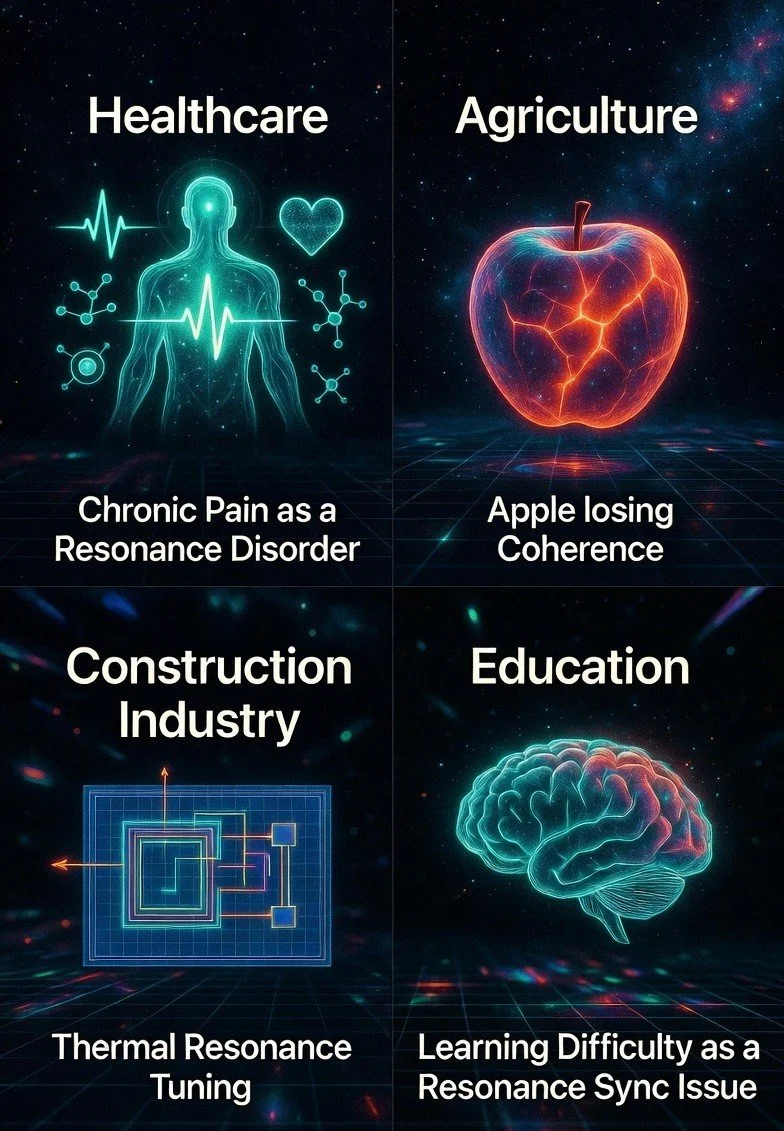
Healthcare
Chronic pain is a resonance disorder. We work with
time-mass synchronization.
Agriculture
An apple does not deteriorate — it loses its coherence.
We maintain resonance.
Construction
Heat loss is thermal resonance tuning.
Education
Learning difficulty is a resonance mismatch.
Transportation
Traffic jams are energy resonance distortion.
The common denominator: coherence, resonance, time-mass harmony. Noir Standard should not be sold — it should be shown.
The Noir Standard has so far mapped temporal coherence in human biology and plant systems.
The Myco-Noir extension steps into the fungal kingdom: exploring whether
mycelial stress responses and therapeutic metabolite production are measurable cross-scale coherence phenomena.
The hypothesis: the persistence of ultrafast hydration-layer dynamics in mycelial tissue
(expressed as a dimensionless Noir Index N°) may predict fungal stress tolerance and the
synthesis of secondary metabolites (e.g., beta-glucans) — beyond established markers.
01 The Problem
Fungi are among the oldest and most expansive living organisms on Earth. Mycelial networks (the "Wood Wide Web")
transport nutrients, communicate via electrical signals, and possess extraordinary stress tolerance. From a medical
standpoint, fungi have been the treasure troves of pharmacology for centuries: from penicillin to beta-glucans and
modern adaptogens.
However, traditional markers (growth rate, biomass, metabolite concentration) only measure
macroscopic consequences. They cannot see what happens at the cellular level, within the
femtosecond-scale water network dynamics — precisely where the fungal stress response
(e.g., oxidative stress, temperature fluctuation, drought) begins.
The question this extension asks is simple and falsifiable:
does the persistence of ultrafast hydration dynamics in the mycelium predict fungal stress tolerance
and therapeutic metabolite production — beyond what established markers already tell us?
02 Level 09 · The Fungal Ultrafast Hydration-Coupling Regime
Level 09 (Tatai-Noir, ≈ 10⁻¹³ s, 100 fs) is the regime of hydrogen-bond vibrations and librations of water.
It is not the timescale of fungal biology. Nothing in this framework assumes that fungal cells or mycelia
themselves change on a 100 fs timescale.
What is fungus-specific is the hypothesis that, in mycelial tissue, this regime
couples to slower events: local protein motions (ps–ns), protein domain movements (µs–ms),
membrane phase behaviour, and cell-wall restructuring (seconds to hours). Level 09 is therefore used as a
coupling regime — not as a threshold, and not as the timescale of fungal biology.
03 Operational Meaning of "Coherence"
In this framework, temporal coherence means the persistence of correlations in the vibrational
frequency fluctuations of hydrating water. It is quantified from 2D-IR spectra as the decay of the frequency–frequency
correlation function (spectral diffusion). Slower decay means higher coherence.
This definition is measurable and replaces any looser use of the word. It is the operational backbone of the entire extension.
MYCO NOIR INDEX · DIMENSIONLESS RATION°(T) = τ_obs(T) / τ_ref(T)τ_obs = spectral-diffusion decay time of sample hydration water · τ_ref = same quantity for matched bulk-water reference · same session, same T
Using a same-temperature reference removes the trivial effect that all water slows on cooling.
N° is not bounded by 1 by construction. The predicted direction — higher N° (longer persistence of hydration correlations)
in more stress-tolerant tissue — is registered before data collection. The test is two-sided,
so that the opposite result is also reported.
04 Timescale Map · Fungal Processes on the Noir Levels
Fungal processes span Levels 07 to 31. The hypothesis only holds if the fast rungs can be linked to the slow ones.
The table uses Level n ≈ 10(n−22) s.
Process
Timescale
Noir Level
Light absorption (electronic excitation)
~10⁻¹⁵ s
07 Femto-Noir
Hydrogen-bond vibrations and librations of water
~10⁻¹⁴–10⁻¹³ s
08–09 (Tatai-Noir at 09)
Water-network rearrangement and reorientation
~10⁻¹² s
10 Pico-Noir
Local protein motions (side chains, loops)
10⁻¹²–10⁻⁹ s
10–13
Ion channel gating
10⁻⁶–10⁻³ s
16–19
Protein domain movements
10⁻⁶–10⁻³ s
16–19
Mycelial growth and hyphal extension
seconds to hours
22–26
Spore dispersal and fruiting body formation
hours to days
24–27
Beta-glucan and secondary metabolite synthesis
~10⁴–10⁶ s
26–28
Adaptation to seasonal stressors
~10⁷–10⁹ s
29–31
05 Therapeutic Potential
The fungal stress response is directly linked to the production of therapeutic compounds. The synthesis of
beta-glucans (immunomodulatory effects), ergothioneine (a potent antioxidant),
and in certain species, psilocybin (psychedelic therapy) is regulated through stress-induced pathways.
If N° predicts stress tolerance and metabolite production, the pharmaceutical industry could optimize
fermentation conditions based on coherence measurements — without waiting months for biomass testing.
This could be revolutionary for precision fermentation.
06 Interactive Visualization
Interactive · Myco-Noir ScaleLIVE
Mycelial Network — Nodes and connections of the mycelial web. Bright points indicate sites of therapeutic metabolite production. Drag to rotate!
The common denominator: coherence, resonance, time-mass harmony. Noir Standard should not be sold — it should be shown.
HOLOHARMONIQ
Science · Technology · Medicine · Humanity
Myco-NoirNEURO-CALIBRATION
ILLUSTRATIVE CONCEPT · NOT A CLINICAL FINDING
Concept loop · three phases of a network
The Psilocybin Resonance
A rigid, highly modular network loosens, passes through a burst of entropy, and reorganises along the branching logic of fungal mycelium. Watch the loop, drag to orbit, or jump to a phase. The mycelial picture is a metaphor; it is not a finding.
Drag to orbit
HOW TO READ THISPsilocybin research reports reduced integrity of the default mode network and higher entropy of brain signals. The link to fungal mycelium is a conceptual analogy chosen for this visual. Node positions, colours and the three meters are illustrative, not measurements. Whether and how any of this helps patients is a question for clinical research.
When a rigid network loosens, a new organisation can form.
HOLOHARMONIQ · MYCO-NEURO LINK · 2026
Illustrative visualization · proposed concept
NanoBred — Concept Overview
Concept overview · Design targets · No measured data
NanoBred™
An edible surface-protection concept for sliced bread
A thin, edible film on the cut surface of bread, being designed to reduce fungal-spore attachment while keeping the bread’s quality acceptable. HoloHarmoniq Ltd. · Noir Standard · Food Systems.
Concept stage. Nothing on this page is a measured result, a product, a regulatory classification or a performance claim. The name NanoBred™ and every “nano” term are working names until a matched measurement package confirms a nanostructure.
01 · The problem
Sliced bread has a different problem from a whole loaf
Mould is expected to start mainly from contamination after slicing, on the exposed, soft and porous crumb, not on the crust. A solution built for crust does not necessarily work on crumb. Source in verification
Spoilage route
Fungal growth
Aspergillus, Penicillium, Rhizopus: surface colonisation and visible mould.
Quality loss
Staling
Starch retrogradation, moisture migration, softening of the crust.
Quality loss
Oxidation
Lipid rancidity, especially in enriched doughs.
02 · The concept
What the film is designed to do
Schematic only: not to scale, not a micrograph, not measured.
Aims to reduce spore adhesionSurface energy tuned so spores attach less (hypothesis H1).
Aims to limit germinationLocal water-activity control and physical interference at the surface (H2).
Aims to keep gas and moisture exchange acceptableAvoid condensation and unwanted moisture build-up; to be measured, not assumed.
Aims to preserve the moisture gradientWith the hope of slowing staling (H4).
03 · Two development pathways
Planning categories, not legal classifications
APathway A
Physical film
A film without a targeted antimicrobial ingredient. Assumed mechanism: surface properties and a physical barrier.
BPathway B
Active film
A formulation that also contains an ingredient with targeted antimicrobial action. Assumed mechanism: physical barrier plus antimicrobial activity.
The final classification depends on the complete composition, the function, the intended use and the target market, and must be confirmed per market by qualified legal and food-regulatory experts.
04 · The first question
Gate 0: does it stick to cut crumb?
Before any long shelf-life study, the programme asks whether a defined, food-compatible formulation adheres reproducibly to cut crumb at acceptable quality. If it does not, the other hypotheses are not yet relevant.
Pass thresholds are fixed in a signed protocol before the first sample is coated, and judged on the lower confidence bound, not on the average. A reviewer independent of the formulation team records the decision.
05 · The programme
Stage gates, from feasibility to independent replication
Crumb-surface feasibility
Adhesion, coverage and quality on real cut slices.
Component characterisation
Surface, transmission and any nanostructure.
Controlled shelf-life study
Time to first visible mould against a named reference.
Blinded, pre-registered test
Confirmation across production batches.
Independent replication
Laboratories outside the HoloHarmoniq network.
06 · Targets and hypotheses
Development targets: not results
ID
Target
Status
T1
At least 30% lower spore attachment in vitro (feasibility screen)
Design target
T2
At least 50% lower spore attachment (exploratory)
Design target
T3
At least 70% lower germination under a defined test (exploratory)
Design target
T4
At least 7 additional mould-free days, read as a difference in time to first visible mould against a named reference system
Design target
T5
No unacceptable sensory or texture deterioration
Design target
Four hypotheses sit behind them: H1 spore adhesion, H2 germination, H3 texture and taste, H4 moisture transfer. For every percentage, the protocol fixes the measured quantity, the denominator, the control and the uncertainty before testing.
07 · Measurement is required
“Nano” only after it is measured
No “nano” claim is made until a measurement package matched to the hypothesised structure has confirmed a nanostructured feature in the final formulated product.
DLSSEMAFMXRDCryo-TEM
08 · Regulation, safety and platform
What has to be true before any use
Regulatory
Classification is open
Edible ingredient or additive, food-contact material or another category, per market (EU, UK, US, Japan and others).
Claims
No free-from claims yet
Wording is finalised only after the composition and the permitted claims are confirmed by experts.
Safety
Evidence before use
Chemistry, migration, toxicology, allergenicity, microbiology and environment. No commercial use until authorisations are in place.
Platform hypothesis
Shared film-forming core, separate application licences. A shared concept is not a shared patent: overlap mapping, prior-art and freedom-to-operate review come first.
A possible extension against a named reference system.
Clean-label fit
Possible fit with consumer demand; wording subject to legal review.
Food waste
Depends on distribution and household behaviour; needs its own evidence.
Sustainability
Possibly less plastic packaging; a lifecycle assessment is needed.
We do not claim. We measure. We validate. We move forward.
NANOBRED™ PLATFORM
HoloHarmoniq Asia × NanoBred
v1.0 · RESEARCH FRAMEWORKPRE-EXPERIMENTAL
Scientific White Paper
A Unified Metrological and Food-Safety Research Framework for Rice and Soybean Surface Protection
The NanoBred™ Platform investigates surface-protection technologies for selected food matrices. The Noir (N°) framework is used as a temporal regime descriptor—it does not replace conventional physical, chemical, or microbiological measurements. No experimental efficacy or safety claims are made in this document.
Executive summary
§0Platform Overview
Two application-specific research programmes are defined: NanoBred Rice™ (focusing on moisture uptake, storage stability, microbiological risks, and cooking quality) and SoyBred™ (focusing on moisture behaviour, mould growth, aflatoxin risk, lipid oxidation, and processing compatibility).
The platform establishes a common research architecture while preserving the distinct biological, chemical, and food-safety requirements of each product.
01 · Scientific background
§1Research Rationale
Food storage stability is influenced by multiple interacting processes: moisture uptake and water activity; surface structure and coating integrity; microbial growth; lipid oxidation; temperature and relative humidity; processing conditions.
Rice presents challenges associated with moisture sensitivity and, in cooked products, microbiological safety. Soybeans introduce additional considerations, including lipid oxidation, protein quality, antinutritional factors, mould growth, and potential aflatoxin contamination.
02 · Platform architecture
§2Four Interconnected Components
2.1 Surface Protection: Coverage, adhesion, abrasion resistance, structural integrity, interaction with moisture, stability during storage and processing.
The Noir (N°) framework is used as a temporal regime descriptor for organising investigations. It is not a substitute for the measurement result itself. Conventional measurements (aw, %, CFU/g, µg/kg, etc.) remain expressed in their established units.
A coating structure with nanoscale dimensions is not automatically associated with Nano-Noir (10⁻⁹ s). Spatial and temporal scales must be treated independently.
Parameter
Conventional Measurement
Water activity
aw
Moisture content
%
Microbial concentration
CFU/g
Aflatoxin concentration
µg/kg
Peroxide value
Method-defined units
Coating thickness
nm or µm
04 · Application I
§4NanoBred Rice™
Product Matrix: Raw/husked/brown rice (moisture, lipid oxidation, mould), white rice (moisture uptake, cooking characteristics), cooked rice (microbiological safety, temperature control).
Food-Safety Consideration: For cooked rice, Bacillus cereus requires particular attention. Spores may survive cooking, and inappropriate cooling can permit growth and toxin formation. The coating must not be treated as a replacement for rapid cooling, refrigeration, safe holding temperatures, and defined storage periods.
Storage Checkpoints
Day 0 (Baseline), Day 3 (Early), Day 7 (Short-term), Day 14 (Short-term), Day 30 (Intermediate), Day 60 (Intermediate), Day 90 (Extended), Day 116 (Quarta-Noir reference horizon).
Note: A 116-day study does not independently establish a 3.17-year shelf life. Aevum-Noir claims require a separate long-term study.
05 · Application II
§5SoyBred™
Product Matrix: Raw soybeans (mould, aflatoxin, lipid oxidation), heat-treated/roasted (lipid oxidation, protein denaturation, trypsin inhibitor), fermented products (separate development branch).
Aflatoxin and Microbiological Safety: Aflatoxin acceptance limits must be confirmed for the exact soybean product category, processing stage, intended use, and destination market. The protocol must not assume a generic aflatoxin limit.
Analytical Methods: HPLC-MS/MS or appropriately validated HPLC for aflatoxin; ISO 3960 for peroxide value; trypsin inhibitor and urease activity for heat-treated products.
06 · Food safety & toxicology
§6Migration and Regulatory Pathway
Investigations should examine coating leaching during washing, soaking, and cooking; migration into cooking water or processing oils; degradation products.
The applicable regulatory pathway depends on the coating's exact composition and intended use. GRAS in the United States and the relevant European Union authorisation frameworks are distinct regulatory matters and require product-specific assessment.
07 · Sensory validation
§7Cooking, Processing, and Sensory
The coating must be evaluated for its effect on water uptake, rehydration, cooking time, texture, structural integrity, taste, aroma, appearance, and cooking-water characteristics. Blinded sensory panels should use predefined evaluation procedures and appropriate control samples.
Replication: A minimum of three independent batches may be used as a preliminary screening design. The final sample size must be justified using expected variability, statistical power, and the intended level of inference.
Each measurement procedure should define the measurand, sampling procedure, analytical method, reference materials, calibration requirements, measurement uncertainty, and repeatability/reproducibility.
The previously proposed ±0.02 N° value remains a target value, not an established performance metric. Uncertainty must be reported for the actual measured quantities in their appropriate units.
Inter-Laboratory Network: For the proposed 200-laboratory network, harmonisation should include common sampling protocols, consistent homogenisation, shared reference materials, comparable analytical methods, documented calibration, and inter-laboratory comparison exercises.
10 · Gate-based decisions
§10Acceptance Criteria
Each application branch must have its own measurable acceptance criteria. Proposed decision outcomes:
PASS: Predefined criteria are met.
STOP: A critical safety, quality, or technical criterion is not met.
REFORMULATE: The formulation or process requires modification and subsequent retesting.
Each gate must specify: measurable acceptance limits, mandatory test methods, minimum sample size, required controls, documented deviation handling, responsible validating laboratory, and data-review procedure.
11 · Implementation plan
§11Sequential Stages
Stage 1: Material and Method Characterisation. Stage 2: Initial Compatibility and Screening. Stage 3: Controlled Storage Studies. Stage 4: Safety and Migration Assessment. Stage 5: Independent and Inter-Laboratory Validation.
Progression between stages requires documented review and approval.
12 · Limitations
§12What This Document Does Not Establish
This white paper does not establish proven shelf-life extension, demonstrated prevention of mould growth, demonstrated reduction in aflatoxin production, confirmed coating safety, regulatory approval, or validated Noir-based predictive performance.
These outcomes require appropriately designed experiments and independent evidence.
Conclusion
The NanoBred™ Platform establishes a unified research architecture for investigating surface-protection technologies in rice and soybeans. Its central principle is the integration of material characterisation, food-matrix compatibility, microbiological and chemical safety, conventional metrology, temporal process mapping, and independent validation.
The objective of this programme is to establish measurable, reproducible, and independently verifiable evidence before any efficacy, safety, or shelf-life claims are made.
NanoBred™ Platform · HoloHarmoniq Asia × NanoBred Research and Validation Framework — Version 1.0 · Pre-Experimental White Paper
Noir Standard · Everyday Life
The Noir Standard in Everyday Life
Coherence · Resonance · Time-Mass Harmony
We are not pointing to the distant future. We are not promising the impossible.
The current possibilities are already available in the present.
The philosophy of HoloHarmoniq™ and the Noir Standard is simple: we see our problems as resonance and coherence problems, and we offer the solution in this language.
Healthcare
Chronic pain is not just "inflammation" – it is a resonance disorder. With the help of the Noir Standard, we work with time-mass synchronization and resonance restoration.
Agriculture
An apple does not deteriorate — it just loses its coherence. We do not preserve — we maintain resonance.
Construction
Heat loss is not just a question of insulation, but thermal resonance tuning.
Education
Learning difficulty? It is not that the student is slow — their resonance is not in sync with the curriculum.
Transportation
Traffic jams are not just logistics — they are energy resonance distortion.
The common denominator in all areas: coherence, resonance, time-mass harmony.
When we see and apply this, everyday problems gain real solutions.
Noir Standard should not be sold.
The new vision should be shown. And once someone sees the world this way — they are already looking for solutions.
Click the image to watch on YouTube
CryoSynth™ · Personalized Nutrition
CryoSynth™
Biotech meets AI — Personalized Nutrition at the Push of a Button
The future of food is here.
CryoSynth™ is a revolutionary biotechnology platform that combines AI-driven molecular synthesis with real-time biological data to create personalized nutrition — molecule by molecule.
What if every school lunch…
every hospital meal…
every family dinner… …was perfectly tailored to your body's needs?
◆ How CryoSynth™ Works
Biotech + AI
Creates meals molecule by molecule, optimized for your biology
Personalized Data
Tailored to your microbiome, insulin sensitivity, activity level, and more
From Child to Grandparent
From a child's favorite dessert to a grandparent's health-optimized dinner
◆ Why It Matters
Prevention, Not Treatment
No more compromise. No more guessing. Just health — served.
Taste, Tailored
Personalized nutrition that tastes like food should — because it is.
◆ From the Same Revolution
CryoFruit™ — Quantum Bio-Intelligence
A revolutionary agricultural breakthrough by HoloHarmoniq.
From the heart of the desert to early snow-covered fields, CryoFruit™ protects crops not with chemicals — but with quantum bio-intelligence.
Turns Arid Soil into Green Orchards
By tuning the Noir resonance of plant roots, CryoFruit™ unlocks water retention and nutrient pathways that deserts could never offer.
Shields Fruit from Frost and Climate Shock
Instead of pesticides or heaters, plants adapt themselves through nanobot-driven bio-memory modulation.
CryoSynth™ Industrial Edition
CryoSynth™ Industrial Edition
Precision Nutrition at Industrial Scale
Hospitals and large kitchens don't need recipes. They need systems.
Throughput
100–200 meals/hour
Nutrition Profiles
AI-controlled
Safety & Traceability
Real-time
Cleaning & Uptime
CIP cleaning & industrial uptime
Same cartridges. Same AI brain. Different throughput.
This is precision nutrition at industrial scale.
Nexus-FoodPrinter · Solar-Powered
Nexus-FoodPrinter
Technology as Global Responsibility
Technology is not a luxury in itself, but a global responsibility.
The HoloHarmoniq Solar-Powered Nexus-FoodPrinter is shown in action in the heart of Africa.
No power grid required. No complicated logistics required — just pure sunlight and the molecular raw materials of CryoFruit™.
Precision
100% precision — every bite
Nutrition
Enriched with vitamins and amino acids
Nexus-AI
Continuously monitors environmental and biological data in the background
This is Everyone's Table: where hunger is eliminated and molecular health becomes a basic right for every humanoid citizen.